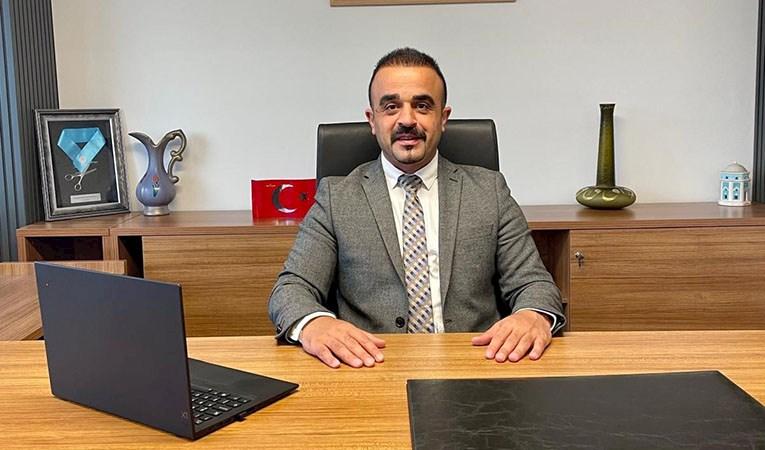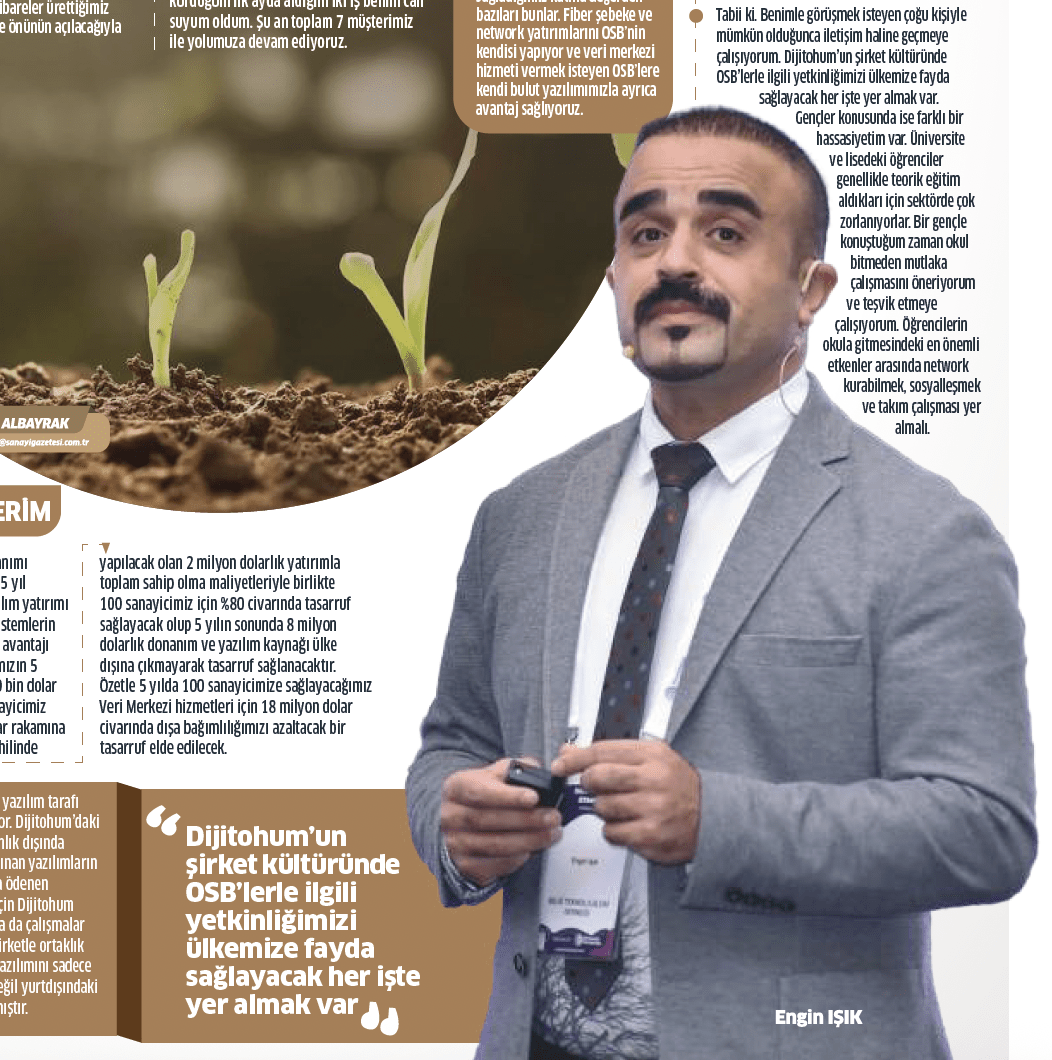
As in the rest of the world, technological advancements are particularly important in Turkey, especially on a sectoral basis. Industrialists need sufficient capital to access technology-related innovations. So, what benefits would Turkey and companies gain if Turkish entrepreneurs produced elements such as software and communication systems? Işık, the founder of Dijitohum, stated that industrial zones, which make significant contributions to the national economy, require technological transformations such as communication and data centers, in addition to providing natural gas, electricity, and water services. He answered frequently asked questions about New Generation Organized Industrial Zones (OSBs).
20 YEARS OF EXPERIENCE
When did you start in the sector? Can you tell us about your professional journey?
I have been in the sector for approximately 20 years. I started in the telecommunications sector; Turkcell, HSBC Bank, Siemens Business Services, Koç Sistem… In 2006, I became acquainted with OSBs and technoparks. I started working at Gebze OSB Technopark. From 2007 to 2021, I served as the Technology Director of Gebze Organized Industrial Zone (OSB). Until Türk Telekom's privatization in 2005, 236 OSBs had funded all their infrastructure from their own resources, transferring their services to Türk Telekom in exchange for services. After privatization, some OSBs used their rights under the OSB law to establish their own communication networks.
Did you implement any projects that deviated from the traditional model during this process?
Most OSBs generally implement traditional projects, often learning from each other. Establishing a fiber network in Gebze OSB after Türk Telekom's privatization and becoming the region's telecommunications provider was a very important vision. Having your own fiber network gives you power. If you have the infrastructure, you can implement any project very quickly; otherwise, you are dependent on another service provider. In 2014, with the concept of cloud computing, we started preparing our data center project. Since our fiber infrastructure was ready, we realized we could provide services such as data backup, data center services, and cybersecurity without making further infrastructure investments. Then, in 2017, we built a data center called Gebze OSB Tower.
"If Organized Industrial Zones (OSBs) are ready in terms of both culture and human resources, these infrastructures can be put up very quickly."
$18 MILLION IN EFFICIENCY THANKS TO INFRASTRUCTURE
Considering the preparation of the infrastructure, is the cost item high?
When you look at the essence of the matter, we are doing a kind of efficiency project. On average, each of our industrialists invests in server and data storage devices along with software licenses every 5 years. In addition, the energy consumption of the hardware installed in the server rooms and the use of air conditioning systems, along with energy consumption costs, reach a total of 10 million dollars over 5 years. Consolidating these systems will provide a significant cost advantage. For example, the average $100,000 spent on hardware and software by one participant over 5 years, when calculated for 100 industrialists, reaches a figure of $10 million. The $2 million investment in the Organized Industrial Zone (OSB) Data Center will provide approximately 80% savings for 100 industrialists, including total cost of ownership, and will save $8 million over 5 years by preventing the outflow of hardware and software resources from the country. In short, over 5 years, we will achieve savings of around $18 million in reducing our dependence on foreign sources for Data Center services for 100 industrialists.
You mention the importance of efficiency. Do you have any planned projects in this area?
Efficiency, especially energy efficiency, is a very important factor because factories use a lot of energy. The OSB can save on energy efficiency, dollars, and software imports, which is a very important issue. There's the software side of things to run the systems, and it constitutes the biggest expense. Besides consulting, our work at Dijitohum also includes software development. Since the fees paid for updating or licensing externally sourced software are not sustainable, Dijitohum is also working in the field of software development. We are partnering with a company called LEO. Our partner LEO has started implementing its cloud software not only in data centers in Turkey but also in centers abroad.
"In Dijitohum's company culture, we utilize our expertise regarding Organized Industrial Zones (OSBs) to participate in any project that will benefit our country."
DATA CENTER PROJECT WITH OWN RESOURCES
Did you do everything with your own resources? Did you not receive any support from the government?
We did it with our own resources. We started generating revenue when we implemented the fiber network service. Because we provided services from our own network, thanks to our collective purchasing power, we both provided services to our industrialists at a lower price than the service fees of telecommunication companies, and the resources remained in the OSB instead of with telecommunication companies. With the revenue we earned from the communication network...
We established a data center. In 2021, I left Gebze Organized Industrial Zone (OSB) to start my own business, sharing the knowledge and experience I gained over nearly 15 years with other OSBs in our country.
Did the development plans and guidelines published by ministries make your work easier?
The Presidency publishes 5-year development plans. Subsequently, the Ministry of Industry and Technology, to which we are affiliated, also published the "2023 Industry and Technology Action Plan." These efforts represent visions that set targets for OSBs. The Ministry is developing strategies to encourage the provision of innovative services to companies within OSBs. For example, statements such as, "A mechanism will be developed and regions will be supported for the central planning and structuring of rapid data communication, industrial cloud, industrial data center, and cybersecurity needs for the vertical integration of companies in OSBs," are roadmaps indicating that our projects will be supported and their path will be cleared.
OUR FIRST GOAL IS TO REACH 20 ORGANIZED INDUSTRIAL ZONES (OIZs)
What are your goals as Dijitohum?
Digitohum was established with the aim of "enabling each OIZ to establish and manage its own technological infrastructure." OIZ stakeholders are no longer satisfied with traditional services and expect different services. The ecosystem that OIZ managements will create by planting seeds for the digital future, and the New Generation OIZs that are the fruit of this ecosystem, will serve as role models for our country in increasing the innovation of companies. In our country, 100 OIZs have completed their basic services and infrastructure. 20 of these OIZs are comparable to the Gebze OIZ, which we can describe as the Champions League of OIZs. When I founded Dijitohum, my first goal was these 20 OIZs, and I set myself a 5-year target. Thankfully, we have reached one-third of the target in 1.5 years. Many people in Turkey with ideas want to sell their projects to the whole of Turkey, but they may not have enough energy, financial resources, and human resources to do so. My biggest stroke of luck was networking with leading figures in the technology sector while working in Gebze Organized Industrial Zone (OSB). The two projects I secured in the first month of founding the company were a lifeline for me. Currently, we continue our journey with a total of 7 clients.
What is needed for a major transformation in an industrial zone?
The organizations I provide consulting services to are generally composed of visionary people with big dreams. These organizations desire changes through innovative approaches, and for these dreams to become reality, they need to have their own fiber optic networks. As an engineering company, we draw up a 5-year macro project and try to complete it in 5 stages. First, it's important to reach all companies by establishing a fiber optic network. After reaching them, the easiest service for us is communication. Based on the dynamics of the OSB, we then present the services requested by the companies to the board of directors. We don't recommend starting all services at the same time. Providing electricity and natural gas services is both a dangerous and difficult process, but most OSBs are able to do it and generate revenue from this infrastructure. This way, they can provide the same service to industrialists at a lower cost while also generating income. These are some of the added value we provide in our Organized Industrial Zones (OIZs). The OIZs themselves make fiber optic network and infrastructure investments, and we also provide advantages to OIZs that want to offer data center services with our own cloud software.
SURVIVING WITH ONLY ONE SOURCE OF INCOME IS DIFFICULT
Are you trying to prevent the migration of young entrepreneurs through collaboration with LEO?
After the recent crises, it's not a good approach for young entrepreneurs to focus their ideas solely on the Turkish market. Companies that do business abroad and don't have a single source of income have survived and even continued to grow. The main goal of our young people and companies is to do business abroad because the Turkish market is very dynamic and narrow. Therefore, rather than migration, it would be more accurate to say that Turkish society has a dynamic structure that can adapt to the situation it finds itself in.
Are the OIZs ready to bear the cost of all the infrastructure work?
Some are ready, of course, but not all. In the projects we're talking about, infrastructure work will be done along with the electricity, natural gas, and wastewater lines, because New Generation OIZs also have to build the communication infrastructure. Although it's difficult to implement this innovation in older Organized Industrial Zones (OIZs), we can take swift action with the solutions we produce in a short time.
Since industrial zones cover very large areas, infrastructure work takes a long time. Do digital infrastructure installations take the same amount of time?
There are two answers to this question. In OIZs that are newly building their infrastructure, it is completed in an average of 6 months. All the infrastructure is established, the data center structure is put up and running, and it starts providing services to all the factories there. However, it should not be forgotten that an OIZ with an area for 500 factories does not have 500 factories operating all at once; they arrive gradually. OIZs